Tuesday, May 18, 2010
What is PayPal and how does it work?
Incantato Tours is transitioning to the use of PayPal to receive tour payments. The following information gives a brief description of PayPal and detailed instructions on how to make your payments. We hope that you will find this method more efficient and significantly safer than sending payments through standard mail, and we thank you for your patience and cooperation during this transition process. For more information about PayPal, please visit www.paypal.com.
PayPal is the faster, safer way to pay and get paid online. The service allows members to send money without sharing financial information, with the flexibility to pay using their account balances, bank accounts, credit cards or promotional financing. With more than 87 million active accounts in 190 markets and 24 currencies around the world, PayPal enables global ecommerce. PayPal is an eBay company and is made up of three leading online payment services: the PayPal global payment service, the Payflow Gateway and Bill Me Later. The company's open payment platform, PayPal X, allows developers to build innovative payment applications on multiple platforms and devices.
Paypal is surprisingly simple to use. Anyone with an email account can successfully conduct business with PayPal. Once you have accessed the website (http://www.paypal.com), first choose the “Send Money” option located at the top of the screen. You will be prompted to fill in the recipient’s email address (info@incantatotours.com), your own email address, and the dollar amount of your payment. Be sure to also indicate, using the tabbed options on the “Send Money” screen, that this payment is for the purchase of services. Continue then to the following screen where you will choose your preferred method of payment (credit, debit, PayPal account, etc.), and fill in the appropriate information. Within moments of completion, Incantato Tours will receive a confirmation email stating that your payment has been added directly to our business PayPal account. Please note that although the money is transferred instantly, it may take up to three business days to appear on your personal financial statements. There are no additional fees when sending money via PayPal.
In an attempt to make the payment process easier for you, we have added a PayPal link to the right side navigation of your blog site (http://bellarmine-incantatotour.blogspot.com/) where you can easily choose the amount you owe and click "Pay Now" to provide your payment information. We hope that you will find this new payment process much more convenient.
Monday, May 17, 2010
Home away from home: Hotel Cetus, Amalfi Coast

The Bellarmine University Performance Tour will stay at the Hotel Cetus as they visit the stunning Amalfi Coast, March 4 through 7, 2011. The Hotel Cetus commands a striking view, perched atop a hill overlooking the bay on the Amalfi Coast. The hotel is less than one mile from the quaint fishing village of Cetara. The elegant furnishings and refined atmosphere are inspired by the local tradition of ceramic art. The Hotel Cetus houses 37 guest rooms, all with beautiful sea-front views. Each room offers air conditioning, private bathrooms, and direct telephone lines. The hotel property also boasts a private beach with American snack bar.
The Hotel Cetus received high reviews from recent travelers who commended the incredibly helpful staff and greatly appreciated the safety and security they felt during their stay. Additional reviews praise the gorgeous views from the clean and comfortable guest rooms.
Labels:
Incantato Hotels
Visit Maiori
Maiori is a town and community on the Amalfi coast in the province of Salerno (Campania, Italy). It has been a popular tourist resort since Roman times, with the longest unbroken stretch of beach on the Amalfi coastline. The origins of the town are unclear but the original name of the town was Reghinna Maior, in contrast to the neighbouring town, Minori, Reghinna Minor. All places along the coast were formed by alternating conquerors - such as the Etruscans or the Romans. Between 830 and 840, the places of the coast united to form a confederation of Amalfi States. In this Amalfi Sea Republic, the places between Lettere and Tramonti and between Cetara and Positano, along with the island of Capri, were united; and their inhabitants were all called Amalfitaner. At that time, each city retained its own name and administrative autonomy, but had a specific role in this federation. Later it became part of the Principality of Salerno, and then of the Kingdom of Naples, of which it followed the history until the 19th century.
Labels:
Incantato Destinations
Sightseeing-Highlight: Pompeii
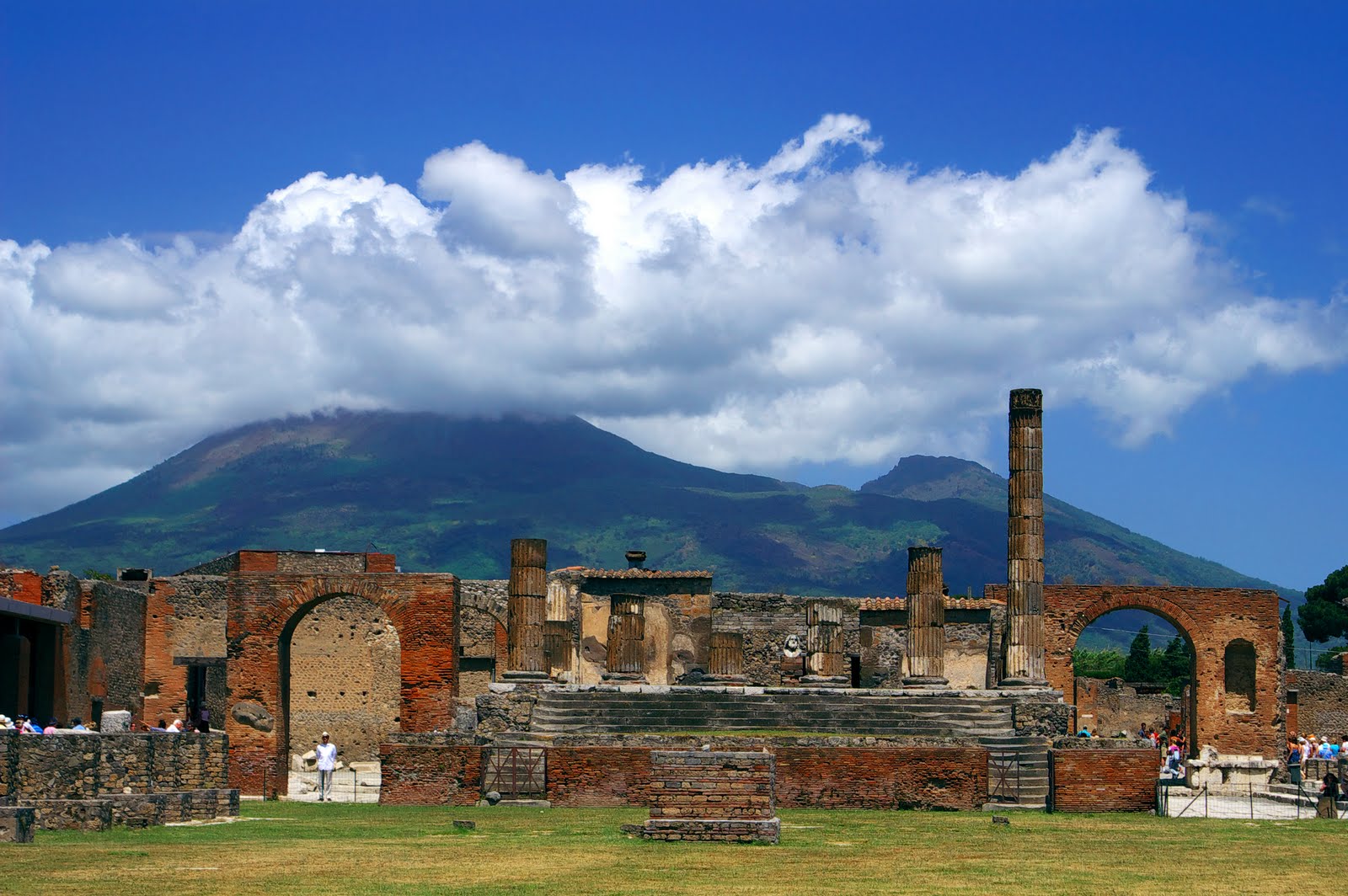
Pompeii is a ruined and partially buried Roman town-city near modern Naples in the Italian region of Campania, in the territory of the commune of Pompeii. Along with Herculaneum, its sister city, Pompeii was destroyed and completely buried during a long catastrophic eruption of the volcano Mount Vesuvius spanning two days in 79 AD. The volcano collapsed higher roof-lines and buried Pompeii under 20 m (66 ft) of ash and pumice, and it was lost for nearly 1,600 years before its accidental rediscovery in 1592. Since then, its excavation has provided an extraordinarily detailed insight into the life of a city at the height of the Roman Empire. Today, this UNESCO World Heritage Site is one of the most popular tourist attractions of Italy, with approximately 2,500,000 visitors every year.
Labels:
Incantato Destinations
About Capri
Capri is an Italian island in the Tyrrhenian Sea off the Sorrentine Peninsula, on the south side of the Gulf of Naples, in the Campania region of southern Italy. It has been a resort since the time of the Roman Republic. In the latter half of the 19th century, Capri became a popular resort for European artists, writers and other celebrities. John Singer Sargent and Frank Hyde are among the prominent artists who stayed on the island around the late 1870s. Sargent is best known for his series of portraits featuring the beautiful local model, Rosina Ferrara. Also in the 19th century, the natural scientist Ignazio Cerio catalogued the flora and fauna of the island. This work was continued by his son, the author and engineer Edwin Cerio, who wrote several books on life in Capri in the 20th century.
The picture is from the official homepage of the Capri tourism office.
Labels:
Incantato Destinations
Incantato Impressions: Capri
Here are just some of the beautiful sights you will see on the island of Capri:
Labels:
Incantato Impressions
Explore Tuscany with Incantato Tours
Tuscany is a region in Central Italy. It has an area of 22,990 square kilometres (8,880 sq mi) and a population of about 3.6 million inhabitants. The regional capital is Florence.Tuscany is known for its beautiful landscapes, its rich artistic legacy and vast influence on high culture. Tuscany is widely regarded as the true birthplace of the Italian Renaissance, and has been home to some of the most influential people in history, such as Petrarch, Dante, Botticelli, Michelangelo, Leonardo da Vinci, Galileo Galilei, Amerigo Vespucci and Puccini. Due to this, the region has several museums, most of which (such as the Uffizi and the Pitti Palace) are found in Florence, but others in towns and smaller villages. Tuscany has a unique culinary tradition, and is famous for its wines (most famous of which are Chianti, Vino Nobile di Montepulciano, Morellino di Scansano and Brunello di Montalcino). Six Tuscan localities have been designated World Heritage Sites: the historical center of Florence (1982), the historical center of Siena (1995), the square of the Cathedral of Pisa (1987), the historical center of San Gimignano (1990), the historical center of Pienza (1996) and the Val d'Orcia (2004). Furthermore, Tuscany has over 120 protected nature reserves. This makes Tuscany and its capital city Florence very popular tourist destinations, attracting millions of tourists every year. Florence itself receives an average of 10 million tourists a year by placing the city as one of the most visited in the world.
Labels:
Incantato Destinations
Visit Florence
- Florence is the most populous city in Tuscany, with 367,569 inhabitants.
- A centre of medieval European trade and finance and one of the richest and wealthiest cities of the time, Florence is often considered the birthplace of the Italian Renaissance; in fact, it has been called the Athens of the Middle Ages.
- The historic centre of Florence attracts millions of tourists each year and was declared a World Heritage Site by UNESCO in 1982.
- It has been the birthplace or chosen home of many notable historical figures, such as Dante, Botticelli, Michelangelo, Galileo Galilei, Roberto Cavalli and Emilio Pucci.
- Florence being historically the first home of Italian fashion is also home to the legendary Italian fashion establishment Salvatore Ferragamo, notable as one of the oldest and most famous Italian fashion houses.
- Florence has been a setting for numerous works of fiction and movies, including the novels and associated films, such as "Hannibal", "A Room with a View", "Tea with Mussolini" and "Virgin Territory".
- The city is one of the great wine-growing regions in the world. The Chianti region is just south of the city, and its Sangiovese grapes figure prominently not only in its Chianti Classico wines but also in many of the more recently developed Supertuscan blends.
Labels:
Incantato Destinations
Italian news: Who owns Michelangelo's "David"?
For 500 years, Michelangelo’s “David” has stood as a symbol of Florentine independence and virtue. However, following a recent report commissioned by the federal government shocked native Florentines by suggesting that Italy—not the city of Florence—was the rightful owner.
As local tempers flared, Florence’s Mayor Matteo Renzi defended the city’s ties to the famous statue.
“The ‘David’ is not an umbrella to be haggled over. It’s a monument in which the city of Florence still sees its identity,” says Renzi. “The sculpture has always and will always belong to Florence.”
Civic pride aside, the dispute over “David” also raises the question of who benefits from Italy’s cultural patrimony. More than one million people visited the Accademia Gallery in 2009 to see “David,” making it the fourth most visited cultural site in the country. Ticket sales exceeded $7 million with the benefits going to the federal Culture Ministry coffers.
Although the question of ownership and related issues surrounding “David” date back to previous administrations, the turning point culminated in early 2010 when the Culture Ministry commissioned a pair of lawyers to analyze official documents. A nine-page document written in dense legalese concludes that “David” belongs to the nation of Italy, the true legal successor of the Florentine Republic, who commissioned the statue in 1501.
Following its completion in 1504, the statue was immediately hailed as a masterpiece and placed in front of the Palazzo della Signoria, which still remains the civic heart of the city. 16th century Italian painter and architect Giorgio Vasari praised the sculpture by claiming that “whoever has seen this work need not trouble to see any other work executed in sculpture, either now in our own or in other times.” The sculpture remained there until 1873 when it was transferred to the Accademia in the Kingdom of Italy. Following the construction of a base for the massive work in 1877, the city could have advanced ownership rights but, according to the lawyers’ report, did not. Therefore, they say, the city has no grounds for claiming ownership.
The mayor, however, had documents of his own stating that Florence had been the capital of the former Kingdom of Italy from 1865 to 1870, and “David” was part of the package deal that the kingdom offered the city when transferring the capital to Rome. Proof of ownership, he said, is in a document dated June 9, 1871, authorizing the transfer of ownership of several buildings to the city, including the Palazzo Vecchio where the statue stood at that time.
In an additional twist, Italian news outlets also reported that Simone Caffaz, the president of the Fine Arts Academy of Carrara, where the marble used for “David” was quarried, believed that Carrara also had the right to make its own claims on Michelangelo’s work.
“If the state and the city actually ever bring this issue to court, it will be terrible publicity for Florence,” fretted Gabriele Toccafondi, a member of Parliament and the local leader of the center-right People of Freedom Party. “People will see this as a sort of commedia all’Italiana.”
On a recent August weekday, dozens of tourists gaped and gawked at “David,” towering in his tribune at the Accademia.
Seeing “David” had definitely been “the highlight of this trip,” said Sorcha O’Keefe, a primary school teacher from Cork, Ireland. But the squabble over “David” made little sense to her. “I can’t see that it would matter who officially owns it, as long as it is there for everyone to enjoy,” she said.
An August 31, 2010 article in the New York Times further discusses the ongoing dispute.
Sunday, May 16, 2010
Visit Montepulciano: birthplace of Saint Bellarmine
Montepulciano is a medieval and Renaissance hill town and commune in the province of Siena in southern Tuscany, Italy, just 77 miles southeast of Florence and 115 miles north of Rome. After the fall of the Western Roman Empire, Montepulciano developed as a religious center under the Lombards. Robert Bellarmine was born here on October 4, 1542 to Vincenzo Bellarmino and his wife Cizia Cervini, the sister of Pope Marcellus II. Robert Bellarmine went on to become a Roman Catholic Cardinal and one of thirty-three Doctors of the Roman Catholic Church. He was active in the movements of the Counter-Reformation and was ultimately canonized by Pope Pius XI in 1930.
Today, Montepulciano is recognized as a major producer of food and drink. The town is known internationally for its top-quality wine. Wine connoisseurs consider its Vino Nobile among Italy’s best. Montepulciano is also known for its pork products, cheese, pici pasta, lentils, and honey. City facts about Siena
Siena is a city in Tuscany, Italy. It is the capital of the province of Siena. The historic centre of Siena has been declared by UNESCO a World Heritage Site. It is one of the nation's most visited tourist attractions, with over 169,000 international arrivals in 2008. Siena is famous for its cuisine, art, museums, medieval cityscape and palio.Siena, like other Tuscan hill towns, was first settled in the time of the Etruscans (c. 900 BC to 400 BC) when it was inhabited by a tribe called the Saina. The Etruscans were an advanced people who changed the face of central Italy through their use of irrigation to reclaim previously unfarmable land, and their custom of building their settlements in well-defended hill-forts. A Roman town called Saena Julia was founded at the site in the time of the Emperor Augustus. The first document mentioning it dates from AD 70. Some archaeologists assert it was controlled for a period by a Gaulish tribe called the Saenones.
Siena's cathedral, the Duomo, begun in the twelfth century, is one of the great examples of Italian romanesque architecture. Its main façade was completed in 1380. It is unusual for a Christian cathedral in that its axis runs north-south. This is because it was originally intended to be the largest cathedral in existence, with a north-south transept and an east-west aisle, as is usual. After the completion of the transept and the building of the east wall (which still exists and may be climbed by the public via an internal staircase) the money ran out and the rest of the cathedral was abandoned.
Over the centuries, Siena has had a rich tradition of arts and artists. The list of artists from the Sienese School include Duccio, and his student Simone Martini, Pietro Lorenzetti and Martino di Bartolomeo. A number of well known works of Renaissance and High Renaissance art still remain in Siena galleries or decorate churches in Siena.
Labels:
Incantato Destinations
Home away from home: Montaperti Hotel in Siena
During their time in Tuscany, March 8 through 10, 2011, the Bellarmine University travelers will stay at Siena’s Montaperti Hotel.Guests are invited to relax in the hotel's panoramic fitness room, steam bath, or sauna, or enjoy a dip in the private swimming pool (covered and heated in the winter).
All standard guest rooms come equipped with wireless internet connection, hairdryer, air conditioning, satellite television, telephone, and electric safe.
In recent reviews, guests praise the hotel's modern and calm atmosphere, the spacious and comfortable guest rooms, and stunning views.
Labels:
Incantato Hotels
Saturday, May 15, 2010
City Facts about Rome
- Rome's early history is shrouded in legend. According to Roman tradition, the city was founded by the twins Romulus and Remus on 21 April 753 BC.
- Due to this centrality on many levels, the city has been nicknamed "Caput Mundi" (Latin for "Capital of the World") and "The Eternal City".
- Its rich artistic heritage and vast amount of ancient, notably architectural and archaeological sites, contribute to the city's UNESCO World Heritage Sites.
- Rome is the third-most-visited tourist destination in the European Union.
- The city is also an important worldwide hub of the cinematic and filming industry, home to the important and large Cinecittà Studios, which saw the filming of several internationally acclaimed movies as well as television programmes.
- The Rome metropolitan area has a GDP of €109.4 billion (US$ 149.14), and according to a 2008 study, the city is the world's 35th richest city by purchasing power.
- The city hosted the 1960 Olympic Games and is also an official candidate for the 2020 Olympic Games.
- Rome is an important centre for music, and it has an intense musical scene, including several prestigious music conservatories and theatres. It hosts the Accademia Nazionale di Santa Cecilia (founded in 1585), for which new concert halls have been built in the new Parco della Musica, one of the largest musical venues in the world.
- A Jewish influence in the Italian dishes can be seen, as Jews have lived in Rome since the 1st century BCE. Examples of these include "Saltimbocca alla Romana" - a veal cutlet, Roman-style; topped with raw ham and sage and simmered with white wine and butter - and "Carciofi alla giudia" - artichokes fried in olive oil, typical of Roman Jewish cooking.
Labels:
Incantato Destinations
Facts about Vatican City

Vatican City, officially the State of the Vatican City, is a landlocked sovereign city-state whose territory consists of a walled enclave within the city of Rome, the capital city of Italy. It has an area of approximately 44 hectares, and a population of just over 800.
Vatican City is a city-state that came into existence in 1929. It is distinct from the Holy See, which dates back to early Christianity and is the main Episcopal see of 1.147 billion Latin and Eastern Catholic adherents around the globe. Ordinances of Vatican City are published in Italian; official documents of the Holy See are issued mainly in Latin. The two entities even have distinct passports: the Holy See, not being a country, only issues diplomatic and service passports; the state of Vatican City issues normal passports. In both cases the passports issued are very few.
Vatican City is an ecclesiastical or sacerdotal-monarchical state, ruled by the bishop of Rome - the Pope. The highest state functionaries are all Catholic clergymen of various nationalities. It is the sovereign territory of the Holy See (Sancta Sedes) and the location of the Pope's residence, referred to as the Apostolic Palace. The Popes have resided in the area that in 1929 became Vatican City since the return from Avignon in 1377.
Labels:
Incantato Destinations
Tour the Vatican Museums and the Sistine Chapel
Incantato's visit to the Vatican Museums & Sistine Chapel will be led by a specialized docent/expert 
guide and is just open to members of your tour. We also provide headsets to everyone for a truly individual experience. This is an exceptional opportunity for an intimate visit and lecture on the Vatican and its impressive art collection without the press and chaos of the crowds.

Please note that not all galleries will be accessible to us during this after hours visit. The Pinacoteca and Egyptian collections are not available for viewing after closing hours. The opportunity to view the Belvedere Courtyard is also dependent on the route the Vatican guards allow us to take. We normally spend a significant amount of time (35-40 minutes) inside the Sistine Chapel and divide the rest of our time between the Gallery of Maps, Tapestry Gallery, and Raphael Rooms, including other collections as time and security permits.
Labels:
Incantato Destinations
Home away from home: H10 Hotel Rome

The Bellarmine University travelers will be staying at the H10 Hotel Rome from March 11 through March 13, 2011.
Located in the Marconi zone near Trastevere, the H10 Hotel Rome combines the most up-to-date trends with a touch of Italian tradition. The hotel, which recently won an award from Tripadvisor readers for being considered one of the trendiest hotels in Europe, offers 181 rooms, outdoor swimming pool and Jacuzzi, solarium,Despacio Beauty Center , and restaurant “Uno Zero Uno” specializing in signature Italian and international cuisine.
Located in the Marconi zone near Trastevere, the H10 Hotel Rome combines the most up-to-date trends with a touch of Italian tradition. The hotel, which recently won an award from Tripadvisor readers for being considered one of the trendiest hotels in Europe, offers 181 rooms, outdoor swimming pool and Jacuzzi, solarium,
Labels:
Incantato Hotels
Subscribe to:
Posts (Atom)